Posted by Adina Hemley-McCay on | Comments Off on Built to Stand Watch: MFI Delivers for America’s 250th
Built to Stand Watch: MFI Delivers for America’s 250th
How Marine Fenders International supported the nation’s Semiquincentennial — from Navy fleet operations to a major East Coast port authority’s own 250th celebration.
This year, America’s ports and waterways are set to host one of the largest maritime gatherings in the nation’s history. As part of the U.S. Navy’s 250th anniversary and the broader Semiquincentennial celebration, ships are converging on harbors across the East Coast — from naval vessels taking part in International Naval Review events, to tall ships arriving from around the world. The main event is the International Naval Review 250 (INR 250), running July 3–8, 2026 in the Port of New York and New Jersey, marking the 250th anniversary of the United States’ founding, bringing together more than 100 ships and 16,000 service members. MFI is proud to be a part of it.
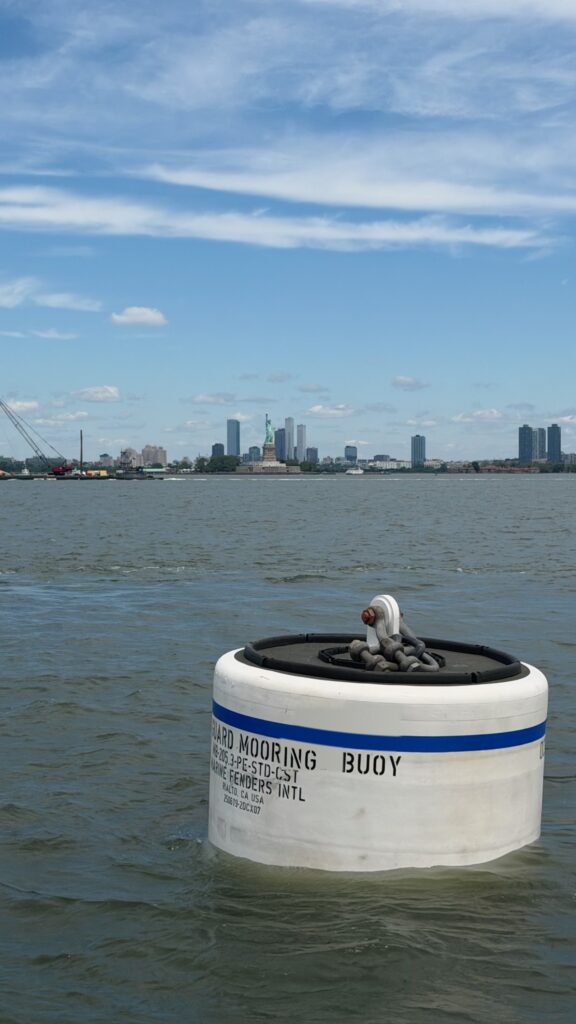
For the Navy’s anniversary festivities, MFI designed, fabricated and supplied Ocean Guard® MB-205 3 PE STD mooring buoys — dependable, proven equipment supporting the very ships taking part in the celebration. We’re hopeful we’ll have photos from the festivities to share with our team and customers in the months ahead.
Built for the Weekend the Whole Harbor Was Watching
At the same time of these 250th anniversary celebrations, coordination took place between the U.S. Coast Guard, NYPD, and New York State on safety and logistics relating to the public ship tours that will be running throughout the weekend. These entities needed mooring buoys that they could count on to offer the permanent anchor system that the public can count on to ensure the ships remain securely parked— delivered on time and built to exact specification. They came to MFI.
Every unit was manufactured at our California facility and put through rigorous testing before it ever left the plant. The central strength member underwent a full pull-strength load test at an independent testing laboratory — The total process from approved engineering drawings, testing, fabrication to delivery took place over a three-month span to ensure the buoys would perform exactly as specified, under real-world load.
BY THE NUMBERS
Once testing was complete, the buoys made the journey from our West Coast manufacturing facility to the East Coast — roughly a week of transit time — arriving on schedule and ready for one of the port’s most visible moments in its history.
3 months design, production time including independent pull testing on the central strength member
800,000 lbs of proof testing for fabricated strength member of each buoy
400,000 lbs of working load for each buoy
~1 week transit time, Southern California to the East Coast Ocean Guard® MB-205 3 PE STD supplied in support of Navy 250th fleet operations
Proud to be part of the celebration. Proud to deliver, coast to coast.
Posted by Jerry Thermos on | Comments Off on Introduction to Marine Buoys
Click to Expand
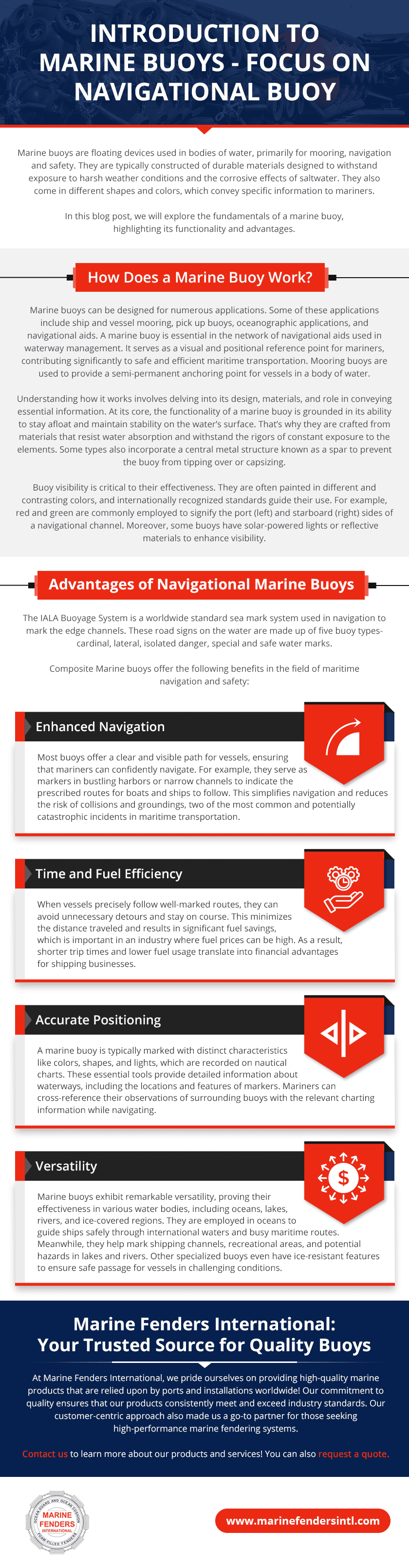
Marine buoys are floating devices used in bodies of water, primarily for mooring, navigation and safety. They are typically constructed of durable materials designed to withstand exposure to harsh weather conditions and the corrosive effects of saltwater. They also come in different shapes and colors, which convey specific information to mariners.
In this blog post, we will explore the fundamentals of a marine buoy, highlighting its functionality and advantages.
How Does a Marine Buoy Work?
Marine buoys can be designed for numerous applications. Some of these applications include ship and vessel mooring, pick up buoys, oceanographic applications, and navigational aids. A marine buoy is essential in the network of navigational aids used in waterway management. It serves as a visual and positional reference point for mariners, contributing significantly to safe and efficient maritime transportation. Mooring buoys are used to provide a semi-permanent anchoring point for vessels in a body of water.
Understanding how it works involves delving into its design, materials, and role in conveying essential information. At its core, the functionality of a marine buoy is grounded in its ability to stay afloat and maintain stability on the water’s surface. That’s why they are crafted from materials that resist water absorption and withstand the rigors of constant exposure to the elements. Some types also incorporate a central metal structure known as a spar to prevent the buoy from tipping over or capsizing.
Buoy visibility is critical to their effectiveness. They are often painted in different and contrasting colors, and internationally recognized standards guide their use. For example, red and green are commonly employed to signify the port (left) and starboard (right) sides of a navigational channel. Moreover, some buoys have solar-powered lights or reflective materials to enhance visibility.
Advantages of Navigational Marine Buoys
Marine buoys offer the following benefits in the field of maritime navigation and safety:
Enhanced Navigation
Most floaters offer a clear and visible path for vessels, ensuring that mariners can confidently navigate. For example, they serve as markers in bustling harbors or narrow channels to indicate the prescribed routes for boats and ships to follow. This simplifies navigation and reduces the risk of collisions and groundings, two of the most common and potentially catastrophic incidents in maritime transportation.
Time and Fuel Efficiency
When vessels precisely follow well-marked routes, they can avoid unnecessary detours and stay on course. This minimizes the distance traveled and results in significant fuel savings, which is important in an industry where fuel prices can be high. As a result, shorter trip times and lower fuel usage translate into financial advantages for shipping businesses.
Accurate Positioning
A marine buoy is typically marked with distinct characteristics like colors, shapes, and lights, which are recorded on nautical charts. These essential tools provide detailed information about waterways, including the locations and features of markers. Mariners can cross-reference their observations of surrounding floaters with the relevant charting information while navigating.
Versatility
Marine buoys exhibit remarkable versatility, proving their effectiveness in various water bodies, including oceans, lakes, rivers, and ice-covered regions. They are employed in oceans to guide ships safely through international waters and busy maritime routes. Meanwhile, they help mark shipping channels, recreational areas, and potential hazards in lakes and rivers. Other specialized floaters even have ice-resistant features to ensure safe passage for vessels in challenging conditions.
Marine Fenders International: Your Trusted Source for Quality Buoys
At Marine Fenders International, we pride ourselves on providing high-quality marine products that are relied upon by ports and installations worldwide! Our commitment to quality ensures that our products consistently meet and exceed industry standards. Our customer-centric approach also made us a go-to partner for those seeking high-performance marine fendering systems.